Bali is home to many unique cultural traditions, and each one often has a special meaning behind it. One of the most interesting is Omed-omedan Bali, a traditional event usually held the day after Nyepi.
If you want to learn more about Bali beyond its beaches and temples, Omed-omedan is definitely worth knowing about. This guide will take you through the story, meaning, and tradition behind Bali’s famous kissing ritual, an event that attracts both locals and tourists every year.
Table of Contents
ToggleWhat Is Omed-Omedan?
Omed-omedan is a Balinese Hindu tradition that comes from Banjar Kaja in Sesetan Village, South Denpasar. It happens once a year, the day after Nyepi, during Ngembak Geni, when Balinese people finally step back out into the world and pick up their everyday activities again. The name itself basically means “pulling each other back and forth,” which is a pretty good description of what actually happens.
Only unmarried young people between 17 and 30, all from Banjar Kaja itself, get to take part. The day starts with prayers together at the temple, then everyone splits into two groups: guys on one side, girls on the other.
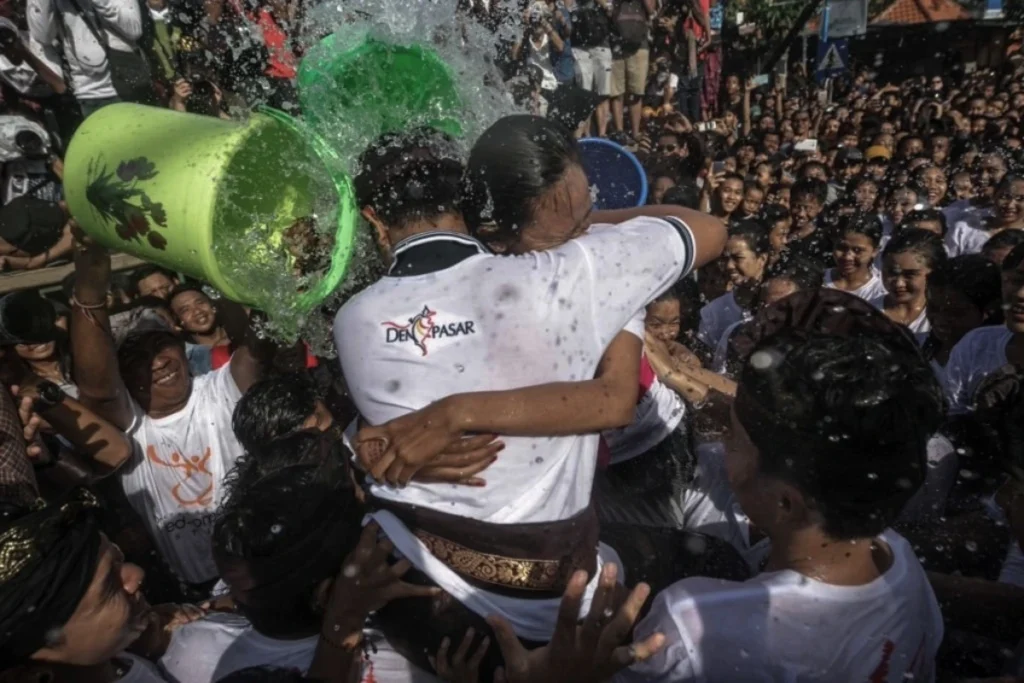
From there, they’re pushed toward each other and get pulled into hugs (called gelut), foreheads or cheeks touch, sometimes lips too (diman), and at some point everyone gets doused with water (siam). The whole thing happens with singing and gamelan music playing in the background, so it feels more like a lively community celebration than anything staged.
Why It Is Called the Kissing Ritual, and Why That Name Misses the Point
Visitors and journalists love calling it a “kissing festival,” and sure, kissing does happen, so it’s not a wrong label exactly. But locals will tell you that framing sells the tradition short. Omed-omedan was never meant to be some free for all makeout session, and reducing it to that misses what it’s really about.
At its core, this Balinese tradition is about togetherness. It’s a way for the community to reinforce care, closeness, and looking out for one another, the kind of bond that holds a neighborhood together. Even the water splashed on participants isn’t just there to break up a hug that’s gone on too long; it’s treated as purifying water meant to wash away bad energy.
Basically, the kissing isn’t the point of omed-omedan. It just naturally happens when two big groups get pulled into a tight embrace. It’s less a show for tourists and more a genuine expression of community spirit that’s been passed down since the 17th century, still alive and well in Sesetan, Denpasar today.
The History and Origins of Omed-Omedan
According to oral tradition, this custom goes back to the 17th century, starting out in the territory of the Puri Oka Kingdom in South Denpasar. It began as something pretty simple: just a tug-of-war game among residents. Over time, it slowly turned into something more physical, with people pulling each other into embraces, and the whole thing just got livelier from there.
The most popular version of the story goes like this: the noise and commotion ended up disturbing the King of Puri Oka, who was seriously ill at the time. But when he finally stepped outside to see what was going on, watching the game somehow cured him.
Because of that, he ordered the event be held every year, specifically during Ngembak Geni, the day fires are lit again after Nyepi. There’s another version too, passed down by local elders, where the sick figure isn’t the king but someone named Ida Bhatara Kompiang. The details differ slightly, but the core is the same: someone important was gravely ill, and residents had been told to keep quiet.
During Dutch colonial rule, the tradition was banned altogether, so residents had to keep it alive quietly, moving it out to the fields. After it stopped completely for a while, something strange happened: two pigs got into a fight right in the temple courtyard.
People took that as a bad sign, and it ended up bringing the tradition back to life. That’s actually why, before the main event today, you’ll see performances of male and female Barong Bangkung (boar-like spirit figures); it’s a nod to that pig-fighting legend.
How the event is run has changed over the decades too. It used to be managed by the banjar (the community council), then shifted over to the sekaa teruna (the local youth group) sometime in the 1990s. The name “Omed-omedan” only became official in the 2000s, and since 2009, the bigger festival version has gone by the name Sesetan Heritage Omed-omedan Festival.
When and Where to Experience Omed-Omedan in Bali
The timing never really changes: it always happens the day after Nyepi, on Ngembak Geni, when life in Bali goes back to normal. Since it follows the Saka calendar though, the actual date shifts a bit each year, but you can generally expect it sometime in March.
As for location, there’s really only one place to see it: Banjar Kaja in Sesetan Village, Denpasar, still the only area that keeps this tradition going today, which is why you’ll often see it referred to as omed-omedan Sesetan.
Since this is a community event run by the local banjar, not some commercial attraction, there’s no ticketing system or published schedule ahead of time. If you actually want to catch it, your best bet is checking with the Denpasar City Tourism Office or keeping an eye on local media as Nyepi approaches.
That said, anyone is welcome to come watch, and over the years more and more visitors have been showing up, especially photographers hoping to capture the moment. Just keep in mind who’s actually allowed to participate: only unmarried local residents from the banjar, aged 17 to 30.
If you’re visiting from outside, you’re there to watch, not join in, which is part of what makes this one of the more unique Bali cultural traditions still going strong, even if plenty of people still just know it as the Bali kissing festival.
Who Takes Part: Sekaa Teruna Teruni and the Role of Pecalang
The people who take part in this omed-omedan tradition come from Sekaa Teruna Teruni (STT), which is basically the youth group at the banjar (local community) level. The rules for who can join are pretty strict: you have to be a native resident of Banjar Kaja Sesetan, unmarried, and somewhere between 17 and 30 years old. Outsiders can’t take part, though anyone’s welcome to come watch.
Even the numbers are set ahead of time: usually around 40 guys and 60 girls join each session, with everyone else waiting as backup for the next rounds. They’re split into two lines, teruna (the men) and teruni (the women), facing each other along the village’s main street.
Since the 1990s, it’s been the STT running the show, a shift from how things used to work when the customary banjar authorities handled it directly.
The pecalang (Bali’s traditional security officers) actually play two jobs here. They help guide the lines as the two groups face off, and they’re the ones splashing water on couples once they’ve embraced, which is basically the signal that a round is over.
So the pecalang aren’t just standing around keeping order. They’re actually part of how the ritual works, deciding when one turn ends and the next one starts.
The Meaning Behind the Pulling: Unity, Duality, and Renewal
Here’s the thing people often miss: the real point of this event was never the kissing. It’s the pulling itself, and there’s a reason for that.
- Unity
At its heart, this tradition exists to strengthen the bond between residents and keep the community feeling close and harmonious. The values behind it come down to asah, asih, asuh, roughly translated as sharpening each other, loving each other, and looking out for each other.
Any kissing or hugging that happens is really just a side effect of how close everyone gets during the pulling, not the goal itself. - Duality
The whole setup is built around two sides facing off: teruna and teruni, men and women, deliberately placed across from each other and then pulled together until they meet in the middle. It’s not a competition with winners and losers. It’s more about showing how two different things can come together and actually complement each other. - Renewal
The timing isn’t random either. It happens right on Ngembak Geni, the first day of the Saka New Year, right after the full day of silence during Nyepi. Even the water that gets splashed on everyone isn’t just there to break up a hug, it’s treated as purifying water meant to ward off bad luck.
So in a way, the whole event closes out the old cycle (all that quiet reflection from Nyepi) and opens up a new one, done together as a community. It’s really not just a fun party. It’s a purification ritual wrapped up in something lively and communal, echoing the balance found in Tri Hita Karana, the Balinese idea of harmony between people, nature, and the divine.
If you’re thinking about catching it yourself, keep in mind the best time to visit is right around Nyepi, typically in March, since that’s the only time this whole thing happens.
Getting to Sesetan and Finding Somewhere to Stand
The event happens on Jalan Raya Sesetan, right in front of the Balai Banjar Kaja (the community hall) in Sesetan Traditional Village, South Denpasar. It’s held out on a public road in a residential area, not inside some ticketed venue.
Since Sesetan sits in southern Denpasar, away from Bali’s usual tourist spots like Ubud, Canggu, or Seminyak, how long it takes to get there really depends on where you’re starting from. Grabbing a ride-hailing taxi or renting a car is probably your best bet, since public transport out that way is pretty limited.
A few practical things worth knowing before you go:
- The main road gets congested, and it’s often closed off to vehicles near the event site once the procession starts. It’s honestly safer to get dropped off or park a bit further away and just walk over, rather than trying to drive right up to the community hall.
- Get there early. This event pulls in thousands of spectators, both locals and tourists, so the good viewing spots along the road near the community hall fill up fast.
- The whole procession runs about two hours, with the main tug of war action happening right in the middle of the road in front of the community hall. That’s the busiest spot, but also where you’ll get the clearest view.
- There’s no official seating, so spectators just stand along the roadside. Wear shoes you’re comfortable standing in for a while.
Watching Respectfully: Etiquette for Visitors
Tourists are absolutely welcome to watch, but keep in mind this is a religious, traditional ritual, not something staged for visitors, so the etiquette is a bit different from your typical festival.
- Don’t step into the procession area. Stay on the roadside and don’t block the path of participants or the pecalang (the traditional Balinese security officers) working the event.
- Listen to the pecalang. They’re the ones keeping order, so if they ask you to step back or move, just go along with it.
- Don’t try to join in yourself. Participation is only for unmarried residents of Banjar Kaja Sesetan between 17 and 30. If you’re visiting, you’re there to watch, not take part.
- Expect to get splashed. Water gets thrown on participants as a signal to stop and as a symbol of purification, and if you’re standing close to the action, you might get wet too, so maybe keep your camera or phone protected.
- Be thoughtful with your photos. Taking pictures is fine, but try to avoid close-ups of people’s faces or using flash directly on them while the tug of war is happening.
- Understand what you’re actually watching. This isn’t just some fun “kissing festival” for entertainment. At its core, it’s about community and spiritual purification as the Saka New Year begins. Go in with respect for the culture, not just looking for a spectacle.
Should You Attend as a Visitor
Honestly, it depends on what you’re after.
Reasons to go:
- This is about as authentic as cultural experiences get. It’s not some show put on for tourists, it’s a genuine ritual that’s been passed down since the 17th century, and locals do it whether or not anyone’s watching.
- It’s completely free, no tickets needed, and it only happens in one place in all of Bali: Banjar Kaja Sesetan.
- The whole experience is genuinely unique. From the communal prayers to the Barong Bangkung dance, all the way to the colorful, high energy tug of war finale, it’s the kind of sequence you won’t really see anywhere else on the island.
Reasons to think twice:
- It gets crowded, hot, and a little chaotic. Thousands of people pack in along the roadside, and there’s no seating or shade to casually watch from.
- You could get splashed with water at any moment without much warning, so it’s not really ideal if you’re carrying electronics or don’t feel like getting wet.
- The date follows the Nyepi calendar, so it shifts every year and only lasts one day. If it doesn’t line up with your trip, you’re basically waiting until next year.
- If you’re expecting some lighthearted “kissing festival” kind of fun, you might be caught off guard. This is a sacred ritual with real spiritual meaning behind it, not just entertainment, so it helps to go in with the right mindset.
- Bottom line: if you’re genuinely curious about authentic Balinese culture and don’t mind a bit of crowding and chaos, this is well worth it. But if you’re looking for something relaxed or predictable, it’s probably not the best fit.
Frequently Asked Questions About Omed-Omedan
- What does omed-omedan mean?
Omed-omedan comes from the Balinese language and means “pulling each other” or “mutual attraction.” The name reflects the main part of the tradition, when two groups of young people take turns pulling and hugging each other in the middle of the street. - When is omed-omedan held?
Omed-omedan is always held one day after Nyepi, during Ngembak Geni. Since it follows the Saka calendar, the exact date changes every year, but it usually takes place around March. - Where is omed-omedan held?
The tradition takes place only in Banjar Kaja, Sesetan Traditional Village, South Denpasar. The event is usually held along Jalan Raya Sesetan, in front of the local banjar hall. - Why is it called a “kissing ritual”?
The name became popular because kissing can happen during the procession. However, locals often explain that omed-omedan is not simply a mass kissing festival, as the main purpose is to strengthen togetherness and solidarity within the community. The kissing happens naturally during the close hugging and pulling between the two groups, rather than being the main goal of the tradition.
What Omed-Omedan Shows About How Bali Keeps a Tradition Alive
Omed-omedan Bali shows how a local tradition can stay meaningful by being passed down, protected, and continued by the community itself. More than a cultural event, it reflects how Bali keeps its heritage alive while allowing new generations to take part in it. For more cultural stories and the best guide to explore Bali, discover more with Insight Bali.