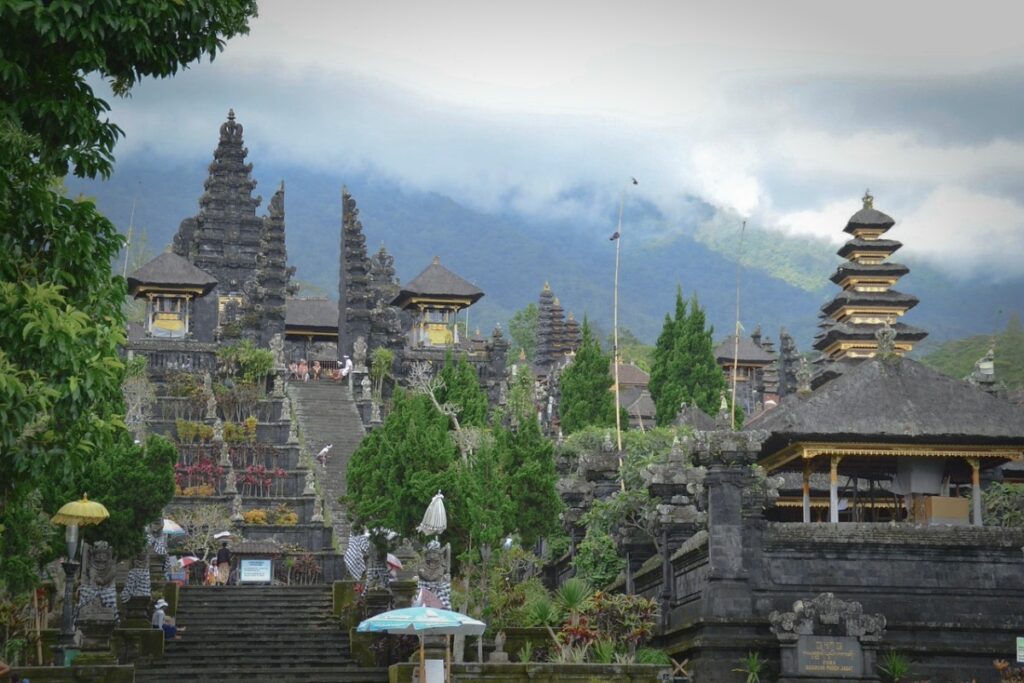
Besakih Temple stands as the largest, holiest, and most sacred Hindu temple complex in Bali. Known as the Mother Temple of Bali, this vast spiritual site holds immense cultural and religious significance, serving as the heart of Balinese Hindu worship for centuries.
In this guide, we’ll take you deeper into Besakih Temple, exploring its rich history, spiritual meaning, and the best time to visit. Consider this your essential introduction to discovering Bali’s most important temple and the powerful heritage it represents.
Table of Contents
ToggleHistory of Besakih Temple
Often called the Mother Temple of Bali, Pura Besakih is the largest and most sacred of all Bali temples, dramatically set on the slopes of Mount Agung. Long before it became the spiritual heart of the island, this area was already revered as a mountain worship site in prehistoric times.
Its spiritual foundation was later strengthened in the 8th century by the holy priest Mpu Markandeya, who planted Panca Datu (five sacred metals) as a symbol of protection and harmony for the land.
The vast complex is made up of 86 temples, with Pura Penataran Agung as the main sanctuary dedicated to the Tri Murti: Brahma, Vishnu, and Shiva. Its terraced, stepped-pyramid layout reflects ancient Megalithic traditions, symbolizing a spiritual journey through layers of the universe toward higher purity.
As one of the most important temples in Bali, Besakih also acts as a unifying center for Balinese clans, each represented by its own ancestral shrine within the grounds.
Pura Besakih is the stage for Bali’s grandest religious ceremonies, some held only once every few decades. One of its most powerful stories dates back to the 1963 eruption of Mount Agung, when lava flows stopped just short of the main temple complex.
This moment is remembered as a sacred sign, reinforcing local belief that Besakih is divinely protected. Today, it stands not only as a spiritual landmark, but also as one of the most meaningful Bali attractions for travelers seeking culture, history, and living tradition.
How Many Temples Are in Besakih
The Besakih Temple Bali complex is truly immense, made up of 86 temples spread across the slopes of Mount Agung. Because of its scale and spiritual importance, the temples are thoughtfully grouped into several categories, making it easier to understand their roles within this sacred site, often known as the Mother Temple Bali.
At the heart of the complex stands Pura Penataran Agung, the main temple and spiritual center of Besakih. Surrounding it are the Catur Lokapala Temples, four shrines positioned in the four cardinal directions, each dedicated to divine guardians who protect the universe from every side.
The largest group within the complex is the Pedharman Temples, which serve as ancestral temples for Balinese clans, reflecting the deep-rooted lineage system and communal identity of the island.
Completing the complex are various supporting temples with more specific purposes, such as spaces for purification rituals (melukat) and temples connected to daily life activities like agriculture.
Together, these temples form a living cultural heritage, symbolizing balance and harmony between humans, nature, and the divine, a philosophy deeply aligned with the Balinese principle of Tri Hita Karana.
Besakih Temple Entrance Fee and Opening Hours
If you’re planning to explore some of the most meaningful places to visit in Bali, Besakih Temple is an experience not to miss. Known as the island’s spiritual heart, this sacred Hindu temple has recently introduced a more organized ticketing system to improve comfort while preserving its holiness.
Entrance Fee at Besakih Temple (2025/2026)
After recent renovations, the Besakih Temple entrance fee is now part of an integrated system that already includes essential facilities for visitors:
- Domestic visitors: IDR 80,000 per person
- International visitors: IDR 150,000 per person
- Children under 6 years old: Free
Each ticket includes:
- Mandatory sarong and sash rental,
- Electric shuttle transport from the main parking building to the temple area, and
- Guide or assistance from a local guide to help visitors understand the cultural and spiritual significance of this historic Hindu site.
Parking Fees
- Motorcycle: IDR 5,000
- Car: IDR 10,000
- Bus: IDR 50,000
Opening Hours
For general sightseeing, Besakih Temple is open daily from 7:00 AM to 6:00 PM WITA. As an active place of worship and one of the most important Hindu temples in Bali, the complex remains open 24 hours for prayer and religious ceremonies.
Dress Code and Temple Etiquette
Visiting Besakih Temple means entering an active religious site, so showing respect through your clothing and behavior is essential. This simple temple guide will help you understand what’s expected during your visit.
- Dress Code: What to Wear
The Besakih Temple dress code applies to all visitors, men and women alike. Modest attire is a must to honor the sacred atmosphere.
You’ll need to wear a sarong and a waist sash to cover your legs below the knees. If you don’t bring your own, these are usually included with your entrance ticket and provided at the Manik Mas parking area.
For tops, make sure your shoulders are covered. A simple t-shirt or shirt works well. Avoid sleeveless tops, low-cut outfits, or clothing that exposes your back, as these are considered inappropriate inside temple grounds. - Entry Restriction During Menstruation
Across all temples in Bali, including Besakih, women who are menstruating are not permitted to enter the inner temple areas. This guideline is based on spiritual beliefs rather than social judgment.
If you still wish to visit, you may stay in the outer areas or around the parking complex, but you should not climb the main stairs or enter the prayer zones. - Temple Etiquette: How to Behave
Proper temple etiquette is just as important as dressing correctly. Avoid climbing on shrines, altars, or temple structures for photos. These are sacred spaces, not photo props.
If a ceremony is taking place, never position yourself higher than the priest (pemangku), and be mindful not to block or interrupt worshippers bringing offerings. Using flash photography directly in front of people praying is also discouraged.
Keep the temple clean by not littering, lowering your voice, and avoiding harsh language. A calm and respectful attitude goes a long way in honoring the spiritual energy of this sacred place.
Travel Tips for Visiting Besakih Temple
- Arrive as Early as Possible (8:00 AM – 9:00 AM WITA)
The slopes of Mount Agung are easily covered in fog after noon. By arriving early, you have a better chance of seeing the majestic peak of Mount Agung as a backdrop to the temple and avoid the intense heat of the climb up the many steps. - Use an Authorized Local Guide
Your entrance ticket usually includes the services of a local guide. Take advantage of them not only to explain the history, but also to help you navigate crowded areas, point out the best photo spots, and let you know which sacred areas are permitted and which are not. - Wear Comfortable Footwear
The Besakih complex is vast and consists of many steep stone steps. Avoid slippery sandals or high heels. Comfortable walking shoes or hiking sandals will help you explore the temple complex to the top without getting tired. - Prepare Small Cash
Although the entrance fee is included, you may need cash to purchase drinks around the area, make voluntary donations (dana punia) at some of the smaller temples, or if you want to hire a motorcycle taxi from the parking area to the temple gate if you don’t want to wait for the shuttle.
Besakih Temple is more than just a landmark; it’s a living symbol of Bali’s spiritual soul, history, and cultural harmony set against the dramatic backdrop of Mount Agung.
From sacred rituals and ancient architecture to meaningful travel etiquette, visiting this Mother Temple offers a deeper understanding of Bali beyond its beaches. For a well-curated journey through this and other iconic sites, Insight Bali is your go-to guide to explore the island with context, respect, and inspiration.