
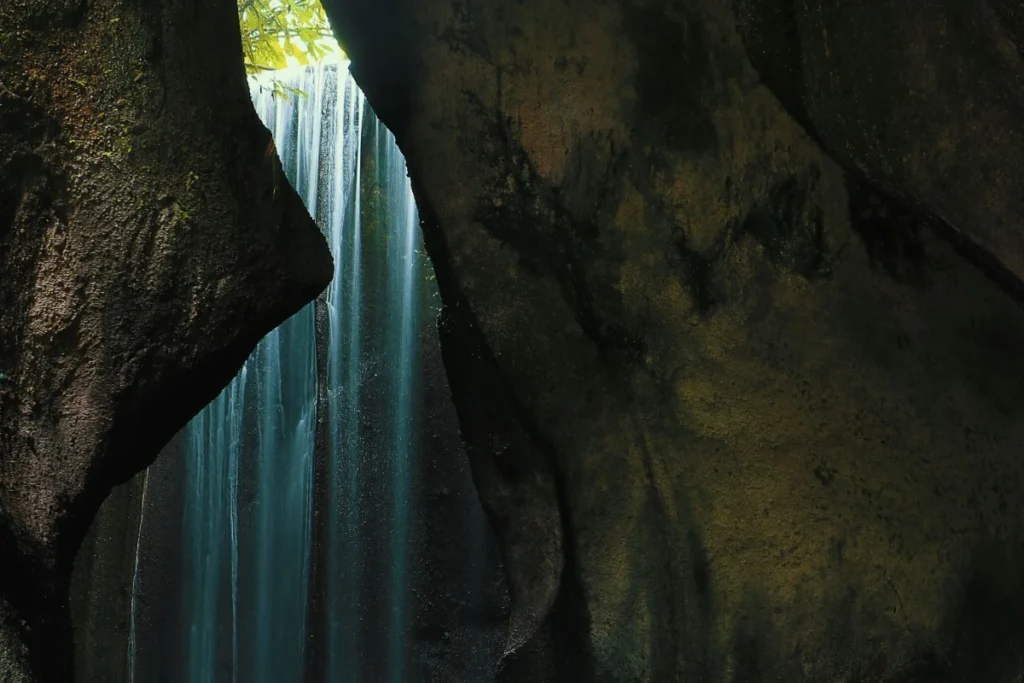
Tukad Cepung Waterfall is a cave waterfall in Tembuku, Bangli, where sunbeams pour through a gap in the canyon ceiling between about 9:00 AM and 11:00 AM, making mid-morning the best time to go. Entry costs around Rp30,000 per person, and the site is open daily from roughly 7:00 AM to 6:00 PM, about 40 minutes to 1 hour from Ubud by car.
This guide covers everything needed to plan the trip, from the entrance fee, opening hours, and directions to the hike, what to pack, swimming, rainy season safety, photo spots, and nearby attractions to combine with the stop.
Table of Contents
ToggleQuick Facts: Tukad Cepung Waterfall at a Glance
Tukad Cepung Waterfall is a cave waterfall in Penida Kelod Hamlet, Tembuku Village, Bangli Regency, East Bali. It is about 15 meters tall, with water falling down the face of a canyon cliff. From the parking area, it is a 15-minute walk, mostly down uneven stone steps.
You can wade and cool off in the shallow pool at the base, but be careful during heavy rain because the current can get strong and rough. Afterward, you can continue to the nearby Goa Raja and Tibumana waterfalls.
Where Is Tukad Cepung Waterfall?
Tukad Cepung Waterfall is in Penida Kelod Hamlet, Tembuku Village, Bangli Regency. This quiet corner of East Bali is away from the busiest tourist routes, yet it is still easy to reach from the island’s main areas.
It is a waterfall near Ubud, about one hour and 28 kilometers away by road. From Kuta or Seminyak, allow 1.5 to 2 hours by car or scooter. The route passes through villages and narrow lanes, so a driver or a reliable map app helps.
Tukad Cepung Waterfall Bali is only a few minutes from Goa Raja Waterfall, another cave-style waterfall, and close to Tibumana Waterfall. You can visit all three in one morning and be back in Ubud for lunch.
Tukad Cepung Waterfall Entrance Fee (2026)
The Tukad Cepung Waterfall entrance fee is about Rp30,000 per person in 2026, based on recently updated travel guides. Parking is reported to be free, so admission is the main cost of the visit. Payment is in cash at the booth near the start of the trail, so bring small bills. The ticket also covers a smaller waterfall a short walk from the main cave, so you get two spots for one price.
Prices at Balinese attractions are set locally and can change without notice. Confirm the amount on arrival, and set aside a little extra for a snack at the warungs along the path.
Why You’ll See Different Prices Online
Tukad Cepung Waterfall tickets range from Rp10,000 to Rp30,000. The gap comes down to timing. The Tukad Cepung cave waterfall was closed for about two years during the pandemic, and the rate has been adjusted since it reopened.
Older blog posts and listings often keep the price from before the closure, which is why Rp10,000 and Rp15,000 still appear on pages that have not been updated.
How the price is presented also adds to the confusion. Tour packages usually include admission in the total, so the fee never shows as a separate line. Travel platforms may display estimates or rounded figures instead of the exact amount charged at the gate. Some listings also bundle entry with extras such as drinks, which makes the number look higher than the fee alone.
For the most reliable figure, use guides updated in 2026 and read recent Tukad Cepung Waterfall reviews on Google Maps. The sign at the ticket booth always has the final word.
Opening Hours and Best Time to Visit
Tukad Cepung Waterfall is open daily from about 7:00 AM to 6:00 PM, all year. The walk down takes 15 to 20 minutes, so arrive at least an hour before closing. That leaves time to explore without rushing back up the stairs in fading light.
Morning vs Midday vs Afternoon: When to Go
- Best Time of Day
The best time to visit Tukad Cepung Waterfall is between 9:00 AM and 11:00 AM on a clear day. At that hour, sunlight comes through the opening in the canyon ceiling and lights the mist in long beams. The effect is usually strongest around mid-morning, and clouds can weaken or hide it. - Best Days of the Week
Weekdays are generally calmer than weekends, which means better photos and shorter queues near the falls. - Best Season
The best time of year for Tukad Cepung Waterfall is the dry season, from April to October, when the hike is safer and more predictable. The wet season, from November to March, brings slippery steps and stronger water in the gorge. - Weather Check
The site may close after heavy rain, so check conditions on the morning of your visit.
How to Get to Tukad Cepung Waterfall
The Tukad Cepung Waterfall location is Jl. Tembuku, Tembuku Village, Bangli Regency. Search for “Tukad Cepung Waterfall” in Google Maps to go straight to the parking area. The last stretch runs along narrow village roads, so drive carefully.
Travel time by starting point:
- Ubud: about 33 km, roughly 40 minutes to 1 hour
- Sanur: about 25 km, roughly 1 hour 15 minutes to 1.5 hours
- Seminyak, Canggu, and Kuta: about 50 km, roughly 1.5 to 2 hours
- Nusa Dua: roughly 1 hour 30 minutes to 1 hour 45 minutes
- Uluwatu: roughly 1 hour 45 minutes to 2 hours
- Denpasar: roughly 1.5 to 2 hours, depending on traffic
Ways to get there:
- Private car with driver:
The most comfortable way to reach the Tukad Cepung waterfall cave in Bali, especially if you plan to stop at Goa Raja Waterfall or Tibumana Waterfall too. The driver waits at the parking area while you go down to the falls. - Scooter rental:
Gives you more freedom, but you need a valid license and should stay alert on the small roads near the site. - Grab or Gojek:
Both can drop you off, but finding a ride back from rural Bangli is unreliable. Arrange your return transport in advance. - Parking and the walk in:
Parking is next to the entrance and usually free, though a small fee of Rp2,000 to Rp5,000 may occasionally be asked. The ticket booth is a short walk from the parking lot.
From there, a long run of stone steps leads down to the stream, and the hike takes about 15 to 20 minutes. The climb back up is the harder part, so stop at one of the cafes along the trail for a break.
The Hike: What to Expect on the Trail
The Tukad Cepung Waterfall hike starts just after the ticket booth. The walk from the parking area takes about 15 to 20 minutes. It is easy on the way down and tiring on the way back up.
- The start: A concrete walkway passes small gardens, jungle, an irrigation ditch, and a few warungs.
- The stairs: Steep stone steps come next, mostly uneven, with a few very tall ones near the bottom. There are railings, but you still need steady footing.
- The riverbed: At the bottom, the trail flattens out near the stream. Turn right to reach a smaller waterfall surrounded by greenery, a good spot for a natural shower.
- The final stretch: Turn left for the main falls. This part is the most adventurous, with a walk through the shallow riverbed and around large boulders, so expect wet feet.
- The climb back: Going up is the real workout. Cafes along the trail make good rest stops, and toilets and showers are available on site.
The stairs make the hike hard for small children, older visitors, and anyone with mobility concerns. Locals also consider the area sacred, so please respect nature and the nearby shrines and temples.
What to Bring and Wear
- Cash in small bills: Entrance tickets are cash only, and small notes also help for coffee, snacks, or a coconut after the climb.
- Shoes with good grip: Steep stairs can be slippery, so flip flops are a poor choice. Strapped sandals or water shoes work best because they stay on while wading and protect your feet from sharp rocks.
- Waterproof phone case: Mist and splashes reach the cave area, so a pouch protects your phone and makes photos easier.
- Sunscreen: The falls are shaded, but parts of the walk in and out are exposed.
- Light, quick-dry clothing: The trail is humid, and breathable fabric stays comfortable on the climb back.
- Change of clothes: Dry clothes are useful for the ride home if you plan to stand under the falls.
Can You Swim at Tukad Cepung Waterfall?
Not really. The water at the base is shallow, usually ankle to shin deep, with a rocky bottom. It is good for wading, cooling off, and standing under the falls for a photo, but not for floating or swimming laps. The water is cool and refreshing after the hike.
For a proper dip, pair this stop with Tibumana Waterfall, which has a deeper plunge pool about 30 minutes away. The smaller waterfall on the right side of the trail is another option for a quick rinse under a gentle stream.
Is It Safe to Visit During the Rainy Season?
Tukad Cepung is open all year, but the best time to visit Tukad Cepung Waterfall is during the dry months, from April to October. Visiting during or right after heavy rain is not recommended. In the wet season, from November to March, the stone steps get slippery and the stream in the gorge can rise quickly. The falls sit inside a narrow canyon, so afternoon thunderstorms can cause flash floods. Avoid staying at the bottom late in the day.
Rain falling further upstream can also send water down toward the falls. The site has been reported closed on days of heavy rain, so confirm the opening hours and conditions before you head out.
If you plan to visit in the wet season, these habits keep the trip safer:
- Go early in the morning, when storms are less likely.
- Check the weather and ask at the ticket booth before heading down.
- Wear shoes with good grip and take the stairs slowly.
- Head back up promptly if the sky darkens or the water starts to rise.
The waterfall flows all year, so there is no need to wait for a certain season to see it.
The Cultural and Spiritual Significance of Tukad Cepung
Tukad Cepung is known for its looks, but it is also part of a living Balinese community. “Tukad” is the Balinese word for river, and the meaning of “cepung” varies by source, with some reading it as flow and others as steep. Locals regard the area as sacred, so visitors are asked to respect the nature and temples nearby.
Signs of daily worship are easy to spot. A shrine sits beside the lawn near the parking area, and more small shrines and temples line the path to the gorge. The waterfall is also close to Pura Dalem Penida Kelod, a village temple that some travel writers call the “Temple of Death.” A Pura Dalem is tied to death and cremation rites in Balinese Hinduism, so the name reflects its role in village life and is not meant to sound ominous.
The site is run by the community. When it reopened after about two years of pandemic closure, the ceremony was attended by the village head, a customary leader, the tourism area managers, and district officials.
A few simple habits show respect:
- Keep your voice low near shrines and temples.
- Dress modestly, especially near the prayer areas by the parking lawn.
- Do not step on or move offerings, and do not climb on shrines for photos.
- Take your trash with you.
- Follow signs and instructions from local staff.
Best Photo Spots and Photography Tips
The light beams are strongest between 9:00 AM and 11:00 AM on a clear day. These are the best spots:
- In front of the main falls: The classic shot, with light rays cutting through the canyon around 9:30 to 10:30 AM. There is often a queue, so be patient.
- From the water, facing the entrance: This angle works well when a beam hits the mist.
- Downstream in the narrow canyon: Light beams also appear here, and it is calmer when the main spot is crowded.
- Looking up from below: The falls cannot be seen from the top, so the view from the bottom, with cliffs and sky above, is the best one.
- The smaller waterfall on the right: A softer and quieter backdrop surrounded by greenery.
- Along the trail: The cafe halfway up has colorful bean bags, and one warung near the parking area has a swing.
A few tips help you get better photos:
- Arrive around 8:00 AM, when only a few people are there. Crowds build from about 10:00 AM.
- Choose a weekday and a clear day, since clouds can weaken the beams.
- Bring a waterproof case and a small cloth for the lens, because mist reaches the cave.
- Take a few frames, then step aside for the next person in line.
Nearby Attractions to Pair With Your Visit
- Goa Raja Waterfall
A few minutes away, this “King’s Cave” waterfall flows inside a cave with a natural pool for swimming. The walk takes about 15 minutes through a mossy canyon, and it is usually quieter than Tukad Cepung. The entrance fee is around Rp25,000. The flow can drop in the dry season when water is diverted to rice fields, so check before you go. - Tibumana Waterfall
About 30 minutes away in Apuan Village. Its deeper plunge pool suits travelers who want a real dip after the shallow water at Tukad Cepung. The walk is around 10 to 15 minutes each way. - Kanto Lampo Waterfall
About 30 minutes south of Goa Raja. This tiered waterfall is known for its rock formations, and visitors often climb the rocks for photos. - Penglipuran Traditional Village
A 15- to 20-minute drive away. The village is known for its traditional Balinese architecture, tidy lanes, and bamboo forest. - Pura Kehen
One of Bali’s oldest and most important temples, in the Bangli area. A flight of stairs lined with stone statues leads up to it. Modest dress is expected. - Tirta Empul Temple
A sacred water temple in Tampaksiring, about 20 km away, famous for its holy spring and purification rituals. - Tegalalang Rice Terrace
A classic East Bali stop, usually added on the way back to Ubud.
Frequently Asked Questions
- Is it suitable for kids and older visitors?
The steep, uneven stairs make it hard for small children, older visitors, and anyone with mobility concerns. - Are there facilities on site?
Yes. Toilets and showers are available, and cafes and warungs line the trail, including a popular rest stop halfway up the stairs. - How much is the entrance fee to Tukad Cepung Waterfall?
The fee is about Rp30,000 per person, paid in cash at the ticket booth. Parking is usually free, though a small fee of Rp2,000 to Rp5,000 may occasionally be asked. - What are the opening hours?
The waterfall is open daily from about 7:00 AM to 6:00 PM, all year. - What is the best time to see the light beams?
Between 9:00 AM and 11:00 AM on a clear day, usually strongest around mid morning. Arriving before 10:00 AM also means fewer people at the falls. - How long does the hike take?
About 15 to 20 minutes each way, mostly down steep stone steps. The climb back up is the harder part.
Planning Your Bali Waterfall Itinerary
Starting the day at Tukad Cepung Waterfall is the easiest way to build a Bali waterfall itinerary, since arriving around 9:00 AM catches the light beams before the crowds build. From there, Goa Raja Waterfall is just a few minutes down the road, and Tibumana Waterfall, with its deeper pool for a proper dip, is about 30 minutes away, leaving time to be back in Ubud for lunch.
For help turning these stops into a smooth route, Insight Bali is the best guide for exploring Bali, with local know-how to match the pace and plans of any trip.